الاكثر قراءةتحليلات و آراءغير مصنف
New York After the Electoral Earthquake: Why Did Zohran Mamdani Win? And Who Actually Lost?
By: Dr. Mohammed Hassan Saad
Director of the Worldview Institute for International Relations and Diplomacy
In the heart of New York- a city that defines itself not merely as a point on the map but as the center of the world- there occurred something akin to a political earthquake. A tremor that did not shake buildings, but unsettled the deeper structures that have long shaped the rhythm of life and power within it.
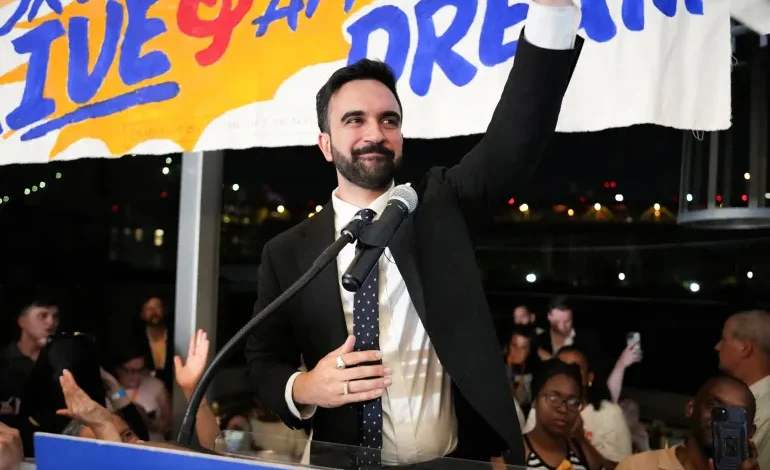
This city of finance, media, and lobbying networks- accustomed to dictating to others the very meaning of “success”- found itself facing a moment of reckoning: How could a young candidate, a democratic socialist of South Asian descent and Muslim faith, surge ahead of a political, media, and financial machine that has been entrenched for decades? This is a victory that cannot be measured by votes alone, but by the meaning carried within those votes. In every working-class neighborhood that cast its ballot for Mamdani, a dual message was being written: the first, that the city wants to be rewritten from the ground up-from the people who pay rent, not those who own the towers, and the second, that the era of cities governed by the logic of markets rather than the logic of justice has reached its ethical end. New York, long seen as a mirror of American capitalism in its most intense form, has begun to redefine itself as a laboratory for social justice -a city learning from itself and confronting its own shadow within the Democratic Party, within the media, and within the networks of the deep state that would prefer Mamdani to remain nothing more than a “temporary electoral phenomenon.”
But this time, the quake, in my view, was too deep to be contained. What happened in New York is not merely an electoral win, it is a shift in the architecture of American political imagination. In essence, it marks a transition from a “city of capital” to a “city of meaning,” from an elite that decides to a grassroots base that redefines the possible.
And from here, the real question emerges:
Why did Zohran Mamdani win? And who actually lost in this battle-one that exceeded the boundaries of the city and struck at the very soul of the Democratic Party itself?
 Loading...
Loading...

 Reload document
  Open in new tab